Wednesday, November 12, 2014

Lil Abner Salutes Orange Crush


As some of you may know my blog post named “Those thevin’ varmints: the imitators of Mountain Dew” I briefly conveyed the story of Nugrape’s Kick-A-Poo Joy Juice which owed its name to the Li’l Abner comic strip, and the creator of that strip, Al Capp. The thing is Kick-A-Poo Joy Juice wasn’t Al Capp’s first venture into soft drink promotion. In fact it was nearly fifteen years prior when Li’l Abner, via Al Capp, announced that Orange Crush was “th’ offishul drink of Dogpatch”. Information on this Orange Crush promotion was almost non-existent until my coming into possession information from the records of the Marion Bottling Company at a bottle show.

Al Capp created his Li’l Abner Comic strip in 1934. The strip is based in the backwoods Kentucky town of Dogpatch, and the main characters are the lovable hillbillies who live in this town and their adventures. The lead character is Li’l Abner, the “Ideel red-blooded American”, and is constantly being romantically pursued by Daisy Mae, which Li’l Abner apparently is oblivious to. By 1950 Capp’s readership had reached 50,000,000 daily readers, and had even created Sadie Hawkins Day which is celebrated by dances where the traditional gender roles are reversed and the women ask the men to the dance. In fact my high school still held a Sadie Hawkins Day dance when I was attending back in the early 90’s. That’s a long run for something based on a comic strip that had stopped being produced in 1978.

As you can see Orange Crush were quite happy to sign the deal with Al Capp in July of 1950 to have Li’l Abner, and the rest of Dogpatch, KY, to promote the soft drink to their fans. Within ten days of the signing of the deal, the Chicago Beverage Company, who held the Chicago Orange Crush franchise, created a thirteen week half hour television show named “Crushable Jones’ Jubilee” which was being filmed on location in a studio at the 1950 Chicago Fair. Crushable Jones was a character specifically created by Capp just for this promotion, and he was basically a hillbilly in a soda jerk hat and a horrible wig which I would bet my life was bright orange. The show was shown on WGN-TV in Chicago which had just hit the airways in April 1948.

The August 1950 edition of Orange Crush’s in house magazine O-C News has a drawing on the cover with Li’l Abner bent over to talk to Crushy, Orange Crush’s mascot, and informing him that he has just received his Dogpatch citizenship papers. In fact the whole issue is devoted to the deal with Capp and announcing that “Orange Crush hitches to a star”. The company even produced special cartons decorated with Li’l Abner characters and designed to resemble log cabins. Of course advertising was a huge part of this campaign which took the form of posters, twenty five different full page ads in Li’l Abner comic books, and premiums to be given away. 

Today the most common surviving premium from this promotion are the fake tattoos featuring Li’l Abner characters, and the envelope they came in which features many of the characters around the table praising Orange Crush. These can be found on ebay at any given time and are often mistaken as being from the thirties. From the looks of the photo from the O-C News there were so many more premiums to be had including inflatable bop figures, comic books, rubber balls, ear muffs, character statues, glasses, clocks, stuffed animals, posters, lamps, and even latex masks. As the ad shows you could get one “offishul dogpatch” rubber mask for only fifty cents with six Orange Crush bottle caps. The offerings were for Daisy Mae, Li’l Abner (as seen worn by one of the actors on Crushable Jones’ jubilee to creepy effect), Lonesome Polecat, and the Wolf Gal.

As to what became of the promotion, or how long it lasted, there just isn’t much information. One thing I do know is that it lasted long enough for a second toned down version of the bottle carrier to be created. But like most promotions, the Orange Crush Li’l Abner one came and went. The remainder of the 1950’s went pretty good for Al Capp and his creation. In 1956 a Broadway musical was created from the comic strip, and eventually in 1959 a feature film was based off that musical. Al Capp retired in late 1977 due to advancing illness, and died on November 5, 1979 of emphysema at 70. His legacy will live on through his character Lil’ Abner and all of his Dogpatch pals.

The front page of the flyer sent to bottlers.

Scan of the front cover of the O-C company magazine covering the promotion.


The art used to create the carton below.


Li’l Abner Orange Crush sign.

Crushable Jones and a guy in a Li’l Abner mask on the television stage in Chicago.

Li’l Abner premiums that were offered during the promotion.

Example of the coupon that could be sent in for the premiums.

Tuesday, January 28, 2014

The House of Lazier Part Two - Just Say Mil-Kay

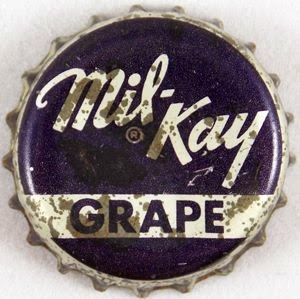
Quite possibly one of the most unsung successful national brands of the past would have to be the Mil-K-Botl brand, or Mil-Kay as it is more commonly known. The history of Mil-Kay starts out with the J. F. Lazier Manufacturing Company of St. Louis Missouri, which was a creator of artificially flavored extracts and concentrates. They would then sell these flavors to bottlers to use in their facilities as their flavor line which was a common base product for any bottler at the time. These flavor extracts were trademarked and included "Little Boy Blue Grape" trademarked on December 29, 1925, "Peter Pan Cherry" trademarked on May 8, 1926, and "Cinderella Orange" which was created in 1921.

In 1927 the company claimed to have created the first Orange Concentrate ever to be made with orange pulp, juice, and tincture of orange peel, which by the mid 1950's was "imitated and sold to all better bottlers throughout the U. S." Mil-K-Botl itself was created in 1935 as a "juice orange drink" which "made it possible for the entire bottling industry to recover the orange business previously lost to the dairies." This is of course referring to the brands of non-carbonated orange drinks such as Mission Orange and Bireley‘s, which were distributed by dairies during the 1920's and 1930's. Mil-K-Botl appears to follow this model of non-carbonation as well, the first bottle is an embossed bottle which has an appearance similar to that of a milk bottle, which is most likely also the origin of the name. The trademark notice for “Mil-k-botl” “and representation of Dutch windmill and oval panel bearing orange disk for carbonated beverages and syrups” was published in April 1939; however, it appears to have been registered in February of that year. They were already using the name on acl bottles prior to this however.

In 1939 they start using a 10oz bottle with "2 ounces of extra glass added" which they claim was copied by the entire industry later on. The earliest acl I have is a 1938 12oz which seems to back up that a conscious decision was made in the Mil-K-Botl brand trending toward 10oz sizes which they have done by 1941. On September 28, 1940 the company files for a trademark change for the brand which shortens the name from Mil-K-Botl to just Mil-Kay and also trademark the phrase "Just Say Mil-Kay" which would be the brand's main advertising tagline until at least the mid 1950's. They would also incorporate the use of vitamin B1 into the formula and sold themselves as "The Vitamin B1 drink". The brand was produced in paper label bottles, and the better known acl bottles which can be found in both blue & white, and black & white. There were three other brands that were also created by the company in the 1920's and 30's those being Dair-E which was an Orangeade trademarked in 1935, Natural Set Up a Lithiated Lemon soda trademarked in 1935, and Sun Drop a "pure orange extract" for which the trademark was filed on December 17, 1929, this brand would become Sun Drop Lemonade by 1937, and would be reformulated into the Sun Drop soda that we know today in 1952.

Some would believe that Mil-Kay was a flavor line picked up by bottlers in World War II so save on having to purchase several different bottles for the different brands they sold. Even though there are Mil-Kay Lemonade, and Mil-Kay Punch bottle caps out there, the Mil-Kay bottles themselves seem to put this in doubt. From my 1941 ACL bottle until 1952 the phrase on the top bar of the back label has always been "Flavored with Fresh Oranges", and from 1942-1944 even the front proudly proclaimed "Orange Phosphate". To further add to my argument the Mil-Kay Orange Corporation of America, which the company was calling itself by then, were hit with a cease and desist ruling from the Federal Trade Commission in 1952 for claiming that the brand was made with real oranges, and the company complied with this order by removing all references to oranges in their advertising, and on the bottles themselves, replacing the top bar on the back with the phrase "A Delicious Taste Treat".

With the success of the reformulating of the Sun Drop formula to the flavor we know today, Charles Lazier, who is the owner of the company by this point, decides to reformulate Mil-Kay into an Orange Cola using a bottle which closely mimicked the successful green Sun Drop bottles, but in clear. The older blue and white label bottles would remain as well into the 1960's; however, the brand seems to taper off during this decade. It appears that the company decides to start transforming into a juice concentrate maker for the dairy industry, and Mil-Kay is transformed into the Apache brand orange juice concentrate which is still being manufactured by the corporation, still owned by the Laziers, which is now known as Rocket Products.

That's the story of one of the most often over looked successful national brand in soda history. With its fairly static bottle designs, and being overshadowed by its more successful cousin, Sun Drop/Golden Girl Cola, I can see why. Yet it deserves its place in soft drink history. At least two local bottlers incorporated the basic design of the bottle into their own, Harman Beverage Company, of Knoxville, Tennessee, actually produced the Hartman Beverage bottle which sold alongside the similarly designed Mil-Kay during the 1950's, and after they dropped the brand Tri-City Beverage, of Johnson City, Tennessee, patterned their own Tri-City Beverages bottles after it as well which they used until the 1980's.

 
Mil-K-Botl was first bottled as a non-carbonated "Orange Juice Drink" which was bottled in this bottle
Cardboard Mil-K-Botl sign showing paper label bottle

12oz Mil-K-Botl bottle dated 1938
Mil-K-Botl matchbook cover
10oz Mil-Kay "A Vitamin B-1 Drink" Blue and White label bottle dated 1941

10oz Mil-Kay "Vitamin drinks are good for you" bottle


10oz Mil-Kay "Orange Phosphate" Blue and White label bottle dated 1942


10oz Mil-Kay "Orange Phosphate" Black and White label bottle dated 1944


10oz Mil-Kay Blue and White label Windmill bottle dated 1946


10oz Mil-Kay Black and White label Windmill bottle dated 1946


10oz Mil-Kay Black and White label bottle dated 1946


10oz Mil-Kay "Vitamin drinks are good for you" bottle dated 1946


10oz Mil-Kay "The Vitamin B1 Drink" bottle dated 1949 from Tri-City Beverages Johnson City, Tenn. Note that it says Flavored With Choice Oranges on the top bar on the back of the bottle.


10oz Mil-Kay "The Vitamin B1 Drink" bottle dated 1952 from Hartman Beverages Knoxville, Tenn. Due to a ruling by the Federal Trade Commission they had to eliminate any suggestion that Oranges were used to make Mil-Kay.


10oz Mil-Kay "Naturally Better" bottle dated 1954 from Tri-City Beverages Johnson City, Tenn


10oz Mil-Kay slim variation bottle dated 1955


7oz Mil-Kay bottle dated 1955. This is the new design for the Mil-Kay Orange Cola bottles, which is based upon the Sun Drop bottles


10oz Mil-Kay bottle with new Orange Cola design


8 3/4oz Mil-Kay "Naturally Better" bottle dated 1957 from Hartman Beverages Knoxville, Tenn

As you can see this sign is an example of the type of advertising that prompted the Federal Trade Commission to rule against Mil-Kay’s claims to be made from real oranges.

10oz Mil-Kay "Naturally Better" bottle dated 1961

Early Mil-K-Botl carrier bag

A wooden Mil-Kay Orange Phosphate six bottle carrier from the early 1940’s

8 3/4oz Hartman Beverages bottle dated 1967 from Hartman Beverages Knoxville, Tenn

10oz Tri-City Beverages bottle dated 1972 from Tri-City Beverages Johnson City, Tenn

Sunday, December 15, 2013

Sunny Isles Sparkling Pineapple Soda


One of the rarest bottles from my local area isn’t actually a local brand as one would expect, but is in reality a franchise brand that had a relatively long history, and very little of it left for researchers like myself to find. I am of course referring to Sunny Isles which while originally just a pineapple flavored soda actually grew into an entire line of drinks before disappearing into history sometime in the late 1950’s or early 1960’s.

Most of what I knew before I started researching came from the records of the now defunct Marion Bottling Company. It appears that they started bottling the brand in 1940; however, according to a 1945 letter from the Sunny Isles Corporation there had been freezing and rationing of pineapple juice brought on by World War II. That combined with the sugar rationing had lost them many of their franchise bottlers except for a few that had continued bottling the brand.

This letter also states that the Murray Company, manufacturers of the Murray Cotton Gin, who apparently had purchased the company, wanted to know if the Marion Bottling Company would be willing to bottle the brand again. The answer was apparently no as the bottler was actively trying to sell the bottles to another bottler in later letters, but finding no buyers. In the last letter I have on the subject the bottler was told by Chattanooga Glass to break them up for cull, which is most likely the reason these bottles are so rare from Marion, VA.

Sunny Isles Inc. was incorporated in the state of Georgia on August 8, 1939, and was originally located in the Hurt Building Suite 1045, Atlanta Georgia. Their first bottle features a red and yellow ACL (Applied Color Label) on green glass featuring a mountain with the sun behind, and Sunny Isles in an arch in front, of it. There are also palm trees on one side and a pineapple plant on the right. This bottle incorporates an embossed texture on the shoulder and heel which mimics the outside of a pineapple. This has to be one of the best examples of a bottle combining an ACL and embossing that I have ever come across which is why I started collecting the brand.

As the aforementioned letter states they had issue within the first couple of years of their existence due to the outbreak of World War II; however, apparently under new ownership they were soon back on track and are located at 420 Courtland Street, Atlanta, GA by 1945. In 1947 they have a new ACL design on their bottles which is basically the same but with Sunny Isles being horizontal rather than arched. The company is actively advertising for franchises in the bottling industry magazines as well. They have once again moved to 237 Trinity Avenue S. W. in Atlanta GA. Yet again they have redesigned the label with new simpler design, and the brand name has a new thinner font which will actually follow the brand throughout the rest of its history.

Having been solely a pineapple soda, Sunny Isles appears to be revamping its image with the introduction of other flavors in the 1950’s. Ko Ko Nut, a flavor mixing both Pineapple and Coconut, was introduced in 1955. In these ads their address is given as 72 11th street N. E., Atlanta, GA. Sunny Isles Tropical Quinine Water is being marketed in 1956 as a chaser for Gin, Vodka, and Rum. Introduced around the same time is Red Mule Ginger Beer which can be mixed with Vodka to create a “Moscow Mule.” From these two flavors the Sunny Isles Tropical Mixers line is created in 1957, which aside from the Tropical Quinine Water and Red Mule, includes a pale dry ginger ale, lemon-grapefruit mixer, and a “professional type” Sparkling Water.

By this point I had guessed that the original pineapple soda that Sunny Isles started as was no longer in existence; however, according to a blurb in one of the bottling industry magazines they are indeed still producing it in 1958. The blurb also states that they have created a new drink mixing grapefruit with pineapple flavors, but they hadn’t yet designed a bottle for this new flavor. So they were offering crowns so that their bottlers could bottle it in their own bottles. This is the last mention of Sunny Isles that I have found. Sunny Isles, Inc. was dissolved officially as a corporation in 1990. There are so many of these lesser known brands in the history of soft drinks in this country that we may never know the history of all of them, but it is always fun to try.

1940 Sunny Isles bottle
 
1948 Sunny Isles bottle

1949 Sunny Isles bottle

Porto Rico Sunny Isles bottle

Sunny Isles bottle cap

Sunny Isles paper label

1949 Sunny Isles ad

1945 Sunny Isles letterhead

Sunny Isles truck